

When planning excavation, drilling, or cutting into concrete, one of the most important steps is identifying what lies beneath the surface. Detecting underground utilities is of utmost importance.
Two of the most commonly used methods for locating underground utilities are ground penetrating radar (GPR) and electromagnetic (EM) locating.
But which one is better?
The answer depends on the project—but in many modern applications, GPR offers the most complete and reliable view of underground conditions.
Electromagnetic locating works by detecting electrical signals on conductive materials.
A transmitter sends a signal through a utility line, and a receiver tracks that signal from above ground to determine the line’s path.
Ground penetrating radar uses radar pulses to scan below the surface and identify changes in material density.
Instead of relying on conductivity, GPR detects anything that contrasts with the surrounding soil or concrete.
While electromagnetic locating has been used for years, today’s job sites often require a more advanced approach.
Ground penetrating radar is widely considered the more comprehensive solution because it can detect both metallic and non-metallic utilities—something electromagnetic locating cannot do on its own.
In environments where:
GPR provides a clearer and more complete picture of what’s underground, helping reduce uncertainty before work begins.
Electromagnetic locating can be useful when:
However, its limitations make it less reliable for projects involving unknown or non-metallic infrastructure.
In many cases, GPR is the preferred method for utility locating—especially on modern job sites where materials and layouts are more complex.
GPR is ideal when:
For many contractors and property owners, GPR has become the go-to solution for reducing risk and avoiding costly surprises during excavation or construction.
The right approach depends on your project, but if accuracy and completeness are priorities, GPR provides a significant advantage.
Whether you’re working on excavation, coring, trenching, or construction, having a clear understanding of underground conditions is essential to keeping your project safe and on schedule.
At GPR Arkansas, we specialize in ground penetrating radar services designed to help contractors, property owners, and project managers locate underground utilities with confidence.
Our team provides accurate, reliable data to help you avoid costly mistakes and move forward safely.
👉 Contact us today to schedule a GPR scan or request a free estimate.
Is GPR better than electromagnetic locating?
GPR is often considered the more comprehensive solution because it can detect both metallic and non-metallic utilities and provide depth information, making it more effective in complex or unknown environments.
Can electromagnetic locating detect plastic pipes?
No, electromagnetic locating cannot detect non-metallic pipes unless a tracer wire is present.
Why is GPR more reliable for modern job sites?
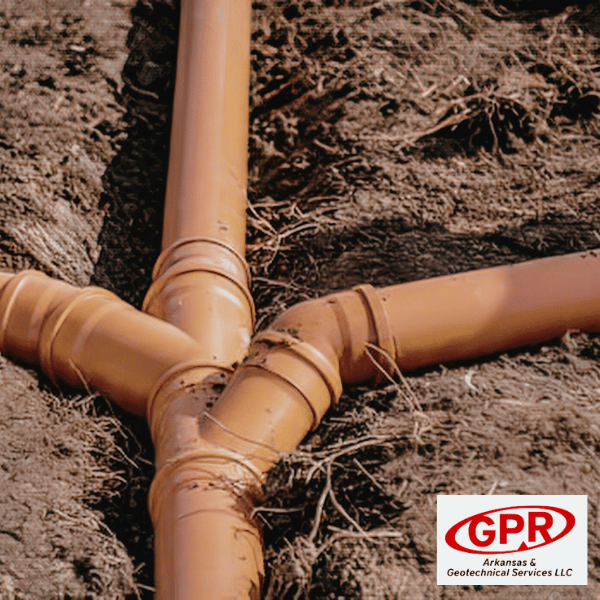
Modern infrastructure often includes non-metallic materials like PVC and fiber optics. GPR can detect these materials, while traditional methods cannot.
| Feature | Ground Penetrating Radar (GPR) | Electromagnetic (EM) Locating |
|---|---|---|
| Detects metallic utilities | ✅ Yes | ✅ Yes |
| Detects non-metallic utilities (PVC, plastic, fiber optic) | ✅ Yes | ❌ No |
| Provides depth information | ✅ Accurate depth estimates | ⚠️ Limited or approximate |
| Requires direct access to utility | ❌ No | ✅ Yes |
| Can detect unknown or undocumented utilities | ✅ Yes | ❌ No |
| Performance in complex environments | ✅ Strong | ⚠️ Can be affected by interference |
| Works in concrete slabs or indoor spaces | ✅ Yes | ⚠️ Limited |
| Relies on electrical conductivity | ❌ No | ✅ Yes |
