

Do you know what’s hiding beneath your business? Every commercial property has sewer infrastructure beneath it, but most business owners have no idea exactly where that infrastructure is until something goes wrong. Too often, they only discover where those sewer lines are accidentally when a contractor hits one.
Luckily, there is a simple, non-invasive solution that can cut out the guesswork and prevent damages before they happen: Ground Penetrating Radar.
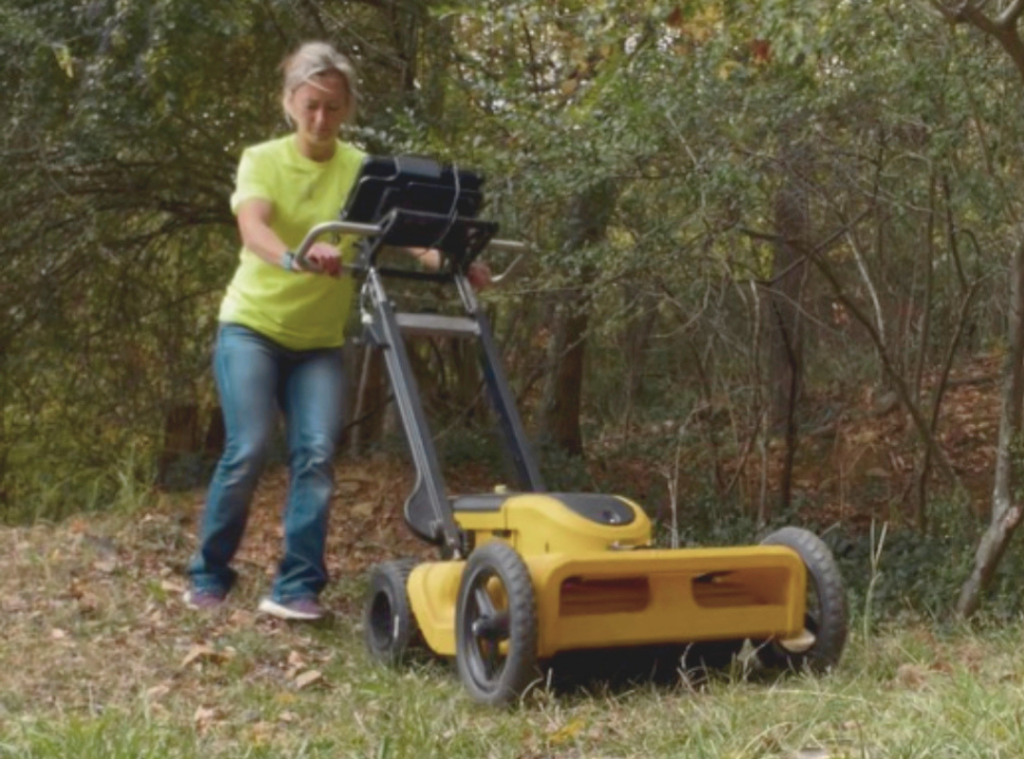
Ground Penetrating Radar (GPR) works by sending radar waves into the ground and measuring what bounces back. It’s similar to how sonar works on a ship—measuring where objects are based on reflected waves—but GPR uses radar waves in the ground whereas sonar uses sound waves in water.
One benefit of GPR is that it can detect a variety of materials, not just metal. Different materials such as soil, clay, pipes, air, and water reflect the radar waves back differently. A trained operator is able to identify what is underground and where it is. Traditional utility locating methods often struggle with non-metallic materials.
If your sewer lines are working properly, they’re probably something you don’t think about often. Out of sight, out of mind. But there are a number of reasons why a business owner might need to know where sewer lines are located under their property.
There are a few reasons why finding sewer lines might be harder than it sounds. For starters, many commercial properties—especially older ones—often have incomplete or missing as-built drawings. When that’s the case, there is no record of where the sewer lines actually are. Similarly, many sewer lines on commercial properties are private lines, which means they aren’t listed in public utility databases. So the simplest way of locating sewer lines (checking the records) is already ruled out.
Additionally, sewer lines are frequently made of non-metallic materials such as PVC or clay. This limits what kinds of methods can be used to locate them. Many traditional methods—such as 811/Call Before You Dig and electromagnetic (EM) locating—can sometimes struggle to find non-metallic materials.
Lastly, there is no uniform depth for sewer lines, so the depth of lines can vary widely. This is another reason why surface-level guesswork isn’t reliable. Even if you accurately guess where a line is located, it can be hard to know exactly how deep it is buried. Luckily, GPR addresses all of these challenges.
GPR is well suited for locating commercial sewer lines, and it has several advantages over other methods. One of the biggest advantages is that it can find both metallic and non-metallic sewer lines. Traditional methods are often less accurate.
Although methods like EM locators can be faster at tracing known lines over a distance, GPR is better suited to sweep an area and find unknown objects. So if a commercial property has missing or unreliable records, GPR will have an easier time locating the unknown lines. Many commercial sites are also on land that has had people living, working, and building on it for decades, so there may be other man-made structures—like storage tanks and clay pipes—underground that no one knows about. A line locate service wouldn’t know to mark those spots, but GPR can give a complete picture of what’s below a site.
A portable GPR cart that’s about the size of a push lawnmower is used to survey the area underground. The cart features a transmitter and an antenna. As the cart passes over a grid-style area, high-frequency radio waves are sent into the ground. When the waves encounter a buried object or the boundary between materials with different properties, the wave bounces back to the surface and is read by the machine. A trained operator can then interpret the results.
GPR works both indoors and outdoors, so it can be used on a slab floor inside a commercial building. Large areas can be scanned efficiently, and GPR can locate the depth of objects as well as their location. It’s non-invasive, quiet, and fast, and initial results are available almost immediately, making it a solid choice for a variety of circumstances.
Like all line locating methods, GPR has some limitations. It requires certain ground conditions to produce accurate readings, so saturated ground can make it more difficult for GPR to work properly. Clay-heavy or very wet soil can also reduce the depth that the signals can reach. And GPR is only as good as the person operating it, so a skilled, experienced operator is essential.
Even with these limitations, the benefits of GPR will often win out over other methods when it comes to locating commercial sewer lines.
For commercial property owners and contractors in Arkansas, locating sewer lines is a vital first step before beginning any excavation, renovation, or construction project. GPR Arkansas can make the process fast and easy. Contact us today for a free estimate, and find out exactly what is hiding beneath your commercial property.
